

Cybersecurity marketing has a remarkable ability to turn a technical improvement into a technological revolution.
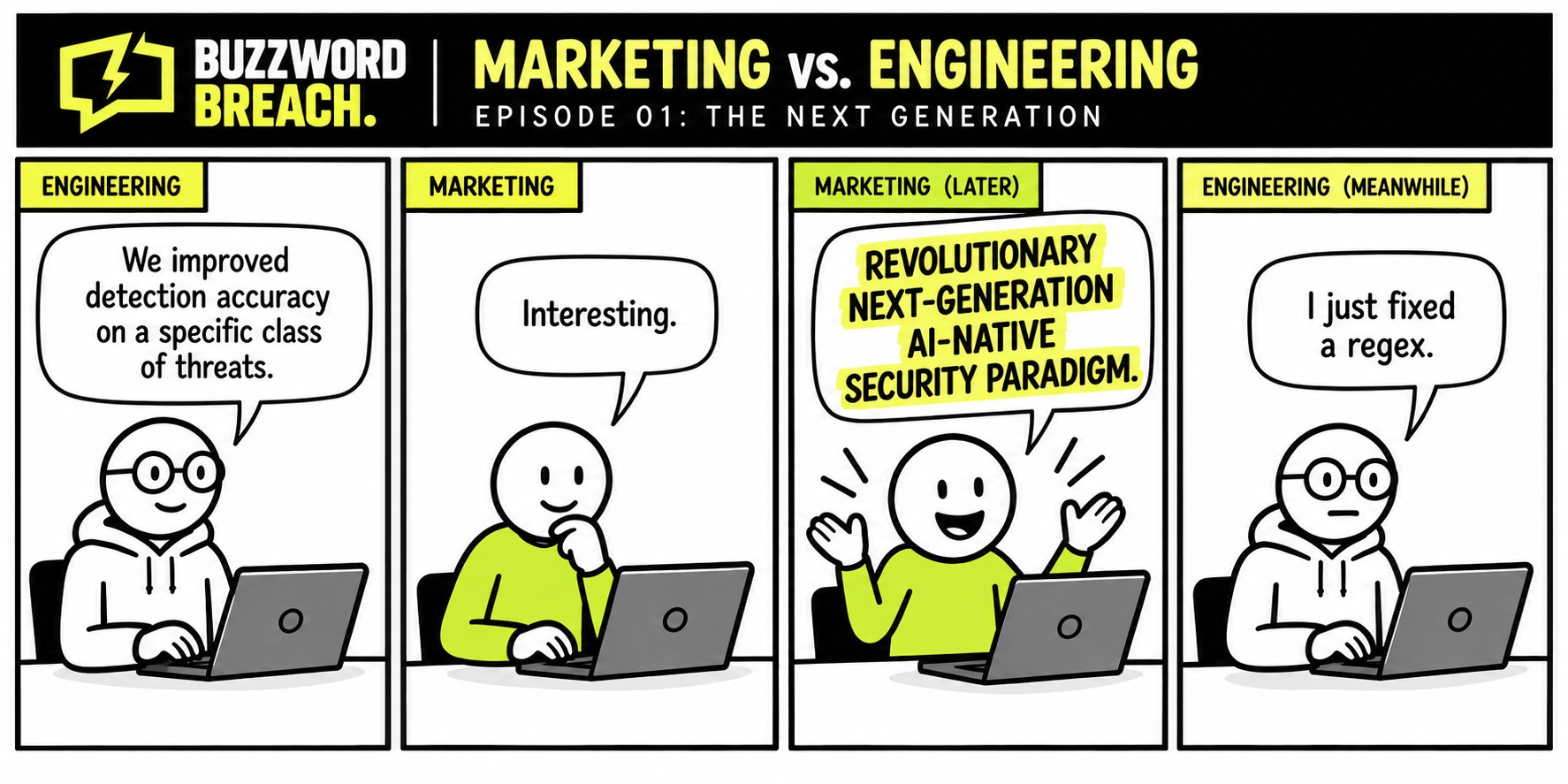
An engineering team improves detection accuracy for a specific class of threats. Perhaps it took weeks of testing, careful tuning and several frustrating debugging sessions. The result is useful, measurable and worth communicating.
Marketing takes a look.
By launch day, the improvement has become a “revolutionary, next-generation, AI-native security paradigm.”
The engineers are still trying to understand how their work became a paradigm.
The problem with making everything revolutionary
Cybersecurity vendors operate in a crowded market where differentiation is difficult. Product capabilities overlap, technical distinctions can be hard to explain, and buyers are constantly exposed to ambitious promises.
It’s understandable that marketing teams want their announcements to stand out.
But when every incremental improvement becomes a breakthrough, the language loses its ability to distinguish genuine advances from routine product development.
“Next-generation” is particularly convenient. It suggests technological superiority without necessarily explaining what has changed, how the improvement works, or which previous limitations have been overcome.
And adding “AI-native” doesn’t automatically answer those questions.
The engineering details are the interesting part
Consider the original claim: improved detection accuracy for a specific class of threats.
For a security practitioner, that’s potentially valuable information. But the details determine its significance.
What types of threats are detected more accurately? Was the improvement measured against representative data? Did it reduce false positives, improve detection rates, or affect both? How does performance change outside the test environment?
An improvement in one metric can involve trade-offs elsewhere. A detection rule that catches more malicious activity might also generate more false positives, depending on how it is tuned.
Those details tell a buyer far more than an adjective describing the product’s generation.
They also give marketing something credible to work with.
Better engineering deserves better marketing
There is nothing inherently unremarkable about an incremental improvement. Security products become more useful through thousands of refinements that rarely justify a new category name.
A well-supported claim about detecting a particular attack technique more accurately can be more persuasive than a sweeping promise of transformation.
Marketing’s job is to make technical progress understandable and relevant. That requires translating engineering work into customer value without inflating the underlying achievement.
The next time engineering delivers an improvement, perhaps the first question should be what the team can demonstrate, rather than how many superlatives will fit into the launch announcement.
And if the biggest achievement was fixing a regex?
Sometimes that is exactly what the product needed.
It probably doesn’t need its own security paradigm.